

`Don't Vote for the Lions,'
LaRouche Urges Michigan Voters
The following is the transcript of a half-hour television spot purchased by Lyndon LaRouche's Presidential campaign, which aired in Michigan on Feb. 13 and on Feb. 19 on WWJ-TV.
Lyndon LaRouche: Most voters today vote like fans cheering at a football game or wrestling match. They vote like Romans, sitting in the grandstand, cheering, watching Christians being torn apart by lions. Most voters today, on the day after the election, begin to wish the candidate for whom they cheered the loudest, had never been born. Now, that may be a slight exaggeration, but not much.
Today, what you're hearing from most candidates on the television debates, so-called, has nothing to do with the leading issues which will decide the fate of this nation in the coming years. We're in the middle, presently, of the worst financial crisis in over 100 years. Exactly when it's going to blow up, no one knows. It could be tomorrow. Japan could blow up and then the U.S. markets would collapse; or a Russian crisis. We have other crises; we have military crises, since the middle of 1998, in various parts of the world: wars, mini-wars, larger wars--patterns of wars spreading all over the place. Ecuador no longer exists as a nation. Venezuela is disintegrating. Colombia is being torn apart. Argentina is disintegrating. Brazil is ready to blow up. Most of Sub-Saharan Africa is disintegrating. The governments of Europe, Germany, and Japan are in deep trouble, and may disintegrate too, under the weight of the new scandals being orchestrated from the United States and from Britain. These issues, which will determine your lives, and determine whether there's any money or not, to pay for health care, or education, or Social Security--these issues are not discussed by these candidates.
The story is, that the voters constitute about 30%, of the total voters who should be eligible to vote--the voters in any election. That of the voters who vote, who determine the outcomes of these elections, most come from the upper 20% of family-income brackets. Most of those in the upper 20% of family-income brackets, make their living, not as we used to, not as top professionals, or as top industrialists used to; they make their money as so-called middle management; in financial and service operations. They get salaries, perhaps, of $50-70,000 a year, and they get stock options bonuses as well. They're up to their ears in hock, and when the $300,000- to million-dollar house caves in because they're not able to pay the mortgage any more, then where will they go? Will the house blow out? Where's a job for them? The nation goes into chaos. Where's that so-called--nonexistent--budget surplus which people keep talking about? It doesn't exist. The system's going. The question is, what do we do about it?
The system is going to blow soon
Now, when the system goes, is not the issue. Exactly how it goes, is not the issue. The only fact is, it's soon. For example, just this past week, and the week before, in Europe and the United States, there was the biggest turbulence, rumbling underneath the markets, that there has been in more than two years. Probably bigger than what happened in 1998, when the LTCM [Long Term Capital Management hedge fund] blew out. Bigger perhaps, than the Brazil crisis of February 1999. Big rumble. Bond markets were involved. Derivatives markets were involved. All kinds of things were involved. The most turbulence we've seen in a long time. So, if you don't know when the system is going to collapse, you know that that turbulence, that rumbling, tells you that something big is going to happen soon. Maybe not the Big One, but a fairly big one. At that time, people are going to have to change the way they think.
They want to know what's going to happen to our economy. What about the local factory, what about the bank? What about the job, what about the community? How do you distribute tax income where the tax income is collapsing, because the economy is collapsing? What do we do about it, then? Well, it's very simple. There are solutions--you go back to the 1930s, to Franklin Roosevelt; and Franklin Roosevelt had an approach, whether you agree with every detail of what he did or not, the man, as President, was committed to the General Welfare, and took emergency measures as needed, to defend the General Welfare. He got us through the Depression, he got us through most of the war, and he laid the basis, in 1944, for a postwar monetary system that worked very well, at least for us and for Europeans. It worked very well until 1959, it worked very well until the middle of the 1960s, and then it began to degenerate. From 1971 on, when Nixon made that foolish mistake he made that August, the world economy, especially the U.S. economy, has been deteriorating. Yes, some people have more money. They have more money because they're able to borrow it, or because they're getting capital financial gains--which they may not be getting for much longer. But most of our population, in the lower 80% of the family-income brackets--and that's only half of the total family income of the nation--they're worse off than they've been before.
You know, people who talk about prosperity and boom, forget. They're the same people who are telling us we can no longer afford the health care we used to be able to guarantee. We can no longer afford the education we used to be able to guarantee. We say we can no longer guarantee Social Security, the way we used to. How is it that we're more prosperous, if these things were true? One of the two has to be false. I'll tell you, it's the first--the "prosperity"--that's false.
Now, how are we going to change this? The politician you're hearing, is generally talking to, mainly--maybe McCain's doing it a little bit differently, maybe Bradley--but generally they're talking to the upper 20% of the family-income brackets, from where they get their campaign money, where they get their voting support. From the strata of the population that controls the bureaucracy of the Democratic and Republican parties. That's who they're speaking to. They're speaking to the money, not to the people. The lower 80%, who live with all these problems--the African-Americans, the Hispanic-Americans, the Asian-Americans, labor, senior citizens--they're not addressing the issues that they face. That's 80% of the families of the United States, who are living in worse conditions, less secure conditions, more perilous conditions, than they have at any time during the past 30 years. Nobody's addressing them.
The vital interests of the nation as a whole
Well, the problem is, you've got to change things. You saw a bit of it in New Hampshire, where the Democratic Party machine, the party bureaucracy, found itself swamped, when the independents went in to vote. Far more people turned out than they expected. And maybe, maybe Bradley actually won that primary; we don't know yet. But certainly, when the independents swarmed over onto the Republican side, they sent George W. Bush to, perhaps much-needed, showers. And it may happen again, probably will. But the point is this: In this nation, the people, who include African-Americans, Hispanic-Americans, Asian-Americans, Arab-Americans, and so forth, they are the ones who are poorly represented. If they can get together around one common issue, the issue of defending the General Welfare for the entire population, they represent--not the so-called top 20%--they represent the power.
My job is to get you to do that. To join with me in bringing together a coalition which represents the vital interests of the nation as a whole, and represents also the vital immediate interests of the lower 80% of our family-income brackets. You've got to turn this election around. Forget the candidates who have pitched to you what you hear now, as the so-called national television debates. Forget it--they're saying nothing. We have a crisis on our hands, it's coming down fast, it's going to hit hard. You need not fear, if you get me as your President, as you get 80% or a good part of them into the polls to vote their vital interests, and the vital interests of this nation.
The real economy has been looted
Let's talk about the issue of the economy. Why is the story you're hearing from the President, and other candidates about the economy, a lot of nonsense? Look at the figure you're seeing on the screen now. Let's call this the Triple Curve [Figure 1]. It's something I've used for a number of years to explain to people in the simplest terms possible, what's wrong with the world and U.S. economy. What went wrong, beginning about 1971, and has been getting worse, ever since.
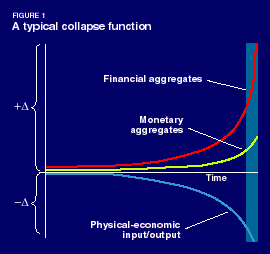
The top curve, the one which, toward the right, zooms upward, is the growth of what we call "financial aggregate." That is the total amount of outstanding claims, of financial value, debt and so forth.
The second one, which also curves up, but more slowly, and is now accelerating in the rate of growth, is called "monetary aggregate." That means money pumped into circulation by central banks and related sources.
The third curve, which points downward, is "physical aggregate." That is the total value, as compared in market-baskets, say, for the years 1966-68, the market value, in physical terms, of the content of a market-basket of food, clothing, housing, education, and so forth, that you receive, as a member of society, as family income. Now, this is going down, per capita, actually. That is, if you compare what you could get with a certain kind of work, say, factory work, in 1966, 1968-69, you will find that the market-basket you get for your work today is actually less, in terms of real, physical value, than it was then. That's why people are working two to three jobs, to try to keep up with--usually unsuccessfully--what they were able to accomplish with one job plus something extra, back 20, 30 years ago.
It's going down. You're losing industries. Where's the factory that disappeared? What happened to the farm that's going out of business? What happened to the infrastructure that's decaying? What about the quality of the goods you get? Junk! Coming from slave labor in some poor country, rather than a good product made in the United States, by U.S. former industrial standards. It's going down.
These three things are related. What has happened, especially since Nixon's decision, of August 1971, is that there's been a gigantic ripoff, worldwide, of looting of previous investments in infrastructure, manufacturing, and so forth--capital investments. Also looting of income, beginning with Phase I and Phase II of Nixon's program. So, the real economy has been looted, in order to extract cash, or the basis for cash, in order to support, through Federal Reserve and similar kinds of discounting, a growth of monetary aggregate--that is, money printing and similar types of vice.
This money, which is printed, now pumps into, on what's called a leveraged basis, into financial speculation, and this really took off after Volcker's foolish measures of 1979-82--Paul Volcker as Federal Reserve chairman. And then, with the Garn-St Germain bill, and the Kemp-Roth bill, the big financial ripoff of America began. And also of the world. You'll find a steady growth, first steady, then going up, financial aggregates, growing and growing, through junk-bond takeovers and things like that, while monetary aggregate increases to fund this--while in the meantime, the real economy contracts.
Now, this has begun to accelerate: 1987 was a turning point; 1992 was another big turning point--1989-92. It's zoomed since then. Now we have, in the world market, well over $300 trillion of pure gambling debts. These are called financial derivatives. The biggest fund of so-called assets and liabilities in the international financial system, are nothing but gambling debts. That is, they are side bets. They're not investments in production. They're not investments in employing people to produce. They're not investments, certainly, in providing more medical services, or health services generally. Not investments in providing more real education. These are pure ripoffs, in which the economy is looted through mergers and so forth, more and more, to feed this bubble of speculation which goes skyrocketing up--and the economy goes down and down. As the economy goes down, what do they do? The Congress and Wall Street begin to talk about entitlements. They say, there are all these entitlements. Government entitlements. Social Security, health insurance, all of these entitlements out there. Education. We can rip 'em off! And that's what they're doing. They're ripping off health care with acquisitions and privatization. They ripping off education, with similar methods. Ripoff! Ripoff! Ripoff!
Financial values skyrocket, derivatives skyrocket, the monetary aggregate increases, to try to keep the financial bubble going. The real economy, goes down. And the lower 80% of the family-income brackets know it. You compare what the percentile was of the U.S. population, which had 50% of the total national income, 30 years ago, 20 years ago, 10 years ago. You find there's a steady growth in the income of the top 20%, which is all tied, chiefly, to financial speculation. There's a steady collapse of the absolute income of people in the lower 80%. So that the people in the top 20% have half of the national family income, while people in the lower 80% have less than half the total, national, family personal income. That's what's happened.
This is a bubble
Now, this bubble is like a chain letter. Some of you are old enough to remember the Pyramid Club scam of 1949-1950. Some of you have read about the South Sea Island and Mississippi bubbles of the early 18th century. Some of you have heard about Ponzi schemes. Some of you have heard about the Tulip Bubble panic in the Netherlands in the seventeenth century. That's what this is. This is not an economy, this is a bubble! And you've got 20% of the upper income brackets are mostly bubble-headed people, who think about nothing but getting more money out of this bubble, which they take their capital gains from the bubble, and they hock them for credit, go more deeply into credit, to buy big mortgages on tar-paper shacks with Hollywood exteriors, and probably some fancy gold faucets in between, in the plumbing.
This is what the nation's become. This is what the world has become. We don't produce our own food any more, the way we used to. When farmers of my generation die, or go out of business, there won't be family farms as we used to know them. The family farms that made America strong--they won't be here. The industries--we don't have the competence to run industries any more, the way we used to. We can't get our satellites to go up properly. We have lost competence, because we've stopped investing in the kinds of employment and activities which once made us the world's leader in technology. Oh, we're still able to bomb a lot of countries; we still have a lot of physical power, while it lasts. But we're not the nation we used to be, any more. And that's the truth about our economy.
Let's think of it. You see the financial values going up. Watch people betting on Wall Street. "Everything is fine! Wall Street--Look at the Wall Street index! Look at the Dow Jones; it's going up, going up! It's great, wonderful! Going up!"
Like a hot-air balloon, going no place, until it pops. But then, look at reality, the reality which is faced by the lower 80% of family-income brackets. Look at the lost factories, the lost jobs, the lost farms, the lost quality of product. You go into a mall to get goods, which are produced by cheap labor, dumped into a mall. You're ashamed even to look at it, let alone buy it. We used to take pride in the quality of what we produced. That's gone, we don't even produce it any more. We're so happy to get slave labor to produce it cheaply, we don't care that much about the quality.
That's the truth about our economy.
Yes, there's a lot more to it, but I thought just this explanation might be helpful to some of you who wonder how you can talk some sense into your neighbor.
The `General Welfare'
That said, now let's talk about the General Welfare itself. Now the term "General Welfare" you probably recognize from the Preamble of the U.S. Federal Constitution. Now that Preamble, taken in its entirety, is actually the fundamental law of our nation, the fundamental, Constitutional law. The rest of the Constitution is an appendix, for implementation of what is summarized in the Preamble.
The Preamble of the Constitution, particularly the phrase on General Welfare, has a big history behind it. Until about 500 years ago, or slightly longer, the nations of European culture were dominated by a form of law called oligarchical law, or imperial law. The populations of these nations had no rights. The authority of law was embodied either in an emperor, or in some oligarchical class and its permanent bureaucracy, such as the Roman imperial permanent bureaucracy, which treated the majority of the population as no better than a convenience, in service of whatever class ruled the government, or controlled it, or owned it.
It was only in the 15th century, beginning with developments in France and then England, the France of Louis XI, the England of Henry VII, that a new form of state was formed, based on the concept of the General Welfare. Another term that was used in the English language to describe this concept of General Welfare, was Commonwealth. You may note, for example, we have a Commonwealth of Massachusetts in the United States, we have a Commonwealth in various other parts--states of the nation. This concept came from that. The United States was actually the first nation, the first modern nation, which was founded on the concept of the General Welfare. There are many people in European nations who share that view, but European governments today are not based on the notion of Commonwealth or General Welfare. The European governments today are reforms, democratic reforms, imposed upon forms of government left over from feudalism. That is, they're called parliamentary governments, in which the people have certain parliamentary rights to influence government, depending upon how many concessions have been obtained, but finally, there's a state bureaucracy, with some pretty powerful financial interests behind it, which will topple governments, by arranging scandals and crises, bringing them down, the way some people tried to bring down Clinton in that funny impeachment process.
Our government is unique. Our Constitution is unique. Our authority in government is this: We say, as the Declaration of Independence made clear, and as the Constitution's Preamble makes clear, that government has no legitimate authority to exist, except as it is committed efficiently to defense and promotion of the General Welfare of all of the population, including posterity. That's what the General Welfare clause means. That means, for example, that for the sake of shareholders, you can not kill people, including senior citizens, by robbing them of the medical care they need. You can not cheat people, by robbing them of their rights in other ways for the sake of the greater profit of shareholders who may have bought a stock 15 seconds ago. That's what the principle is. So the problem today is, that our Supreme Court, or at least the leaders of it, and many other institutions of government, and also the leading political parties at the top, the bureaucracies, no longer respect and recognize the principle of the General Welfare.
They say you have to go along, you have to go along, people have to learn to suffer. We have to sacrifice for the middle, we have to appeal to the suburban vote, people will have to give up this, give up that, give up this. And how does this work? Well, they use the mass media, which they control, to disorient you; they have you sitting in front of a television set like a Roman proletarian living in virtual slavery, sitting in the arena, watching the lions tear Christians apart. You call that entertainment. You get violent, pornographic sex and bloody violence, on TV, or in wrestling matches or whatnot--that's your entertainment. Entertainment values dominate your mind, and through the medium of entertainment, you are influenced against your own vital interests.
You say, which candidate has media appeal? Not which candidate is good for you, but which one is like a movie star, has media appeal. And you go out and vote for that candidate, many of you, or you don't vote at all, because you're disgusted with them all. And see what you get. See the result you get.
So the issue today--we have a growth of racism in the United States, we have a propensity to kill, in police forces and among Governors such as George W. and Jeb Bush, or Gilmore of Virginia, we have a cruel disregard for humanity, which is growing--all in the name of shareholder values. And the 80% of our families are suffering, our nation is suffering, as a result of this. And what do you do? You sit back, and you either don't vote, or you vote for a mass-media-approved candidate. You vote on issues which are dictated by the mass media. What about your interests? What about the interests of your neighbor? What about the interests of 80% of the families of this country, whose conditions of life are becoming progressively worse, more insecure?
Who do you vote for? Why don't you guys get together, you who typify the so-called lower 80% of family income? Instead of talking about my constituency interest, or this little interest here or there, why don't you say, what about the General Welfare? Let's get together and agree, that if we elect political leaders who are committed to the principle of the General Welfare, and regard the General Welfare as the standard by which the legitimacy of government is determined, and we elect people who will vote that way, act that way in government, then we have the kind of government which represents us, and our posterity.
That really is what this campaign is about. I'm the best candidate for President that exists. No one else even matches my qualifications for this kind of job, at this time, under these conditions. But, although I have the best answers, there's nothing I can do for you, unless you're willing to do something for yourself. Get out and vote. Build a coalition, a coalition committed to the General Welfare, especially of the lower 80% of the family-income brackets--senior citizens, people in labor, African-Americans, Hispanic-Americans, Arab-Americans, Asian-Americans--get together. Vote your interests. That's what I represent.
This time, when you go to the polls--and you should go to the polls--vote Christian, or vote Jewish, or vote Muslim. Just please, don't vote for the lions.
